Ever-mushrooming building developments, Chinese traditions and spicy cuisine combine in Sichuan's capital.
 |
| Central Chengdu Getty |
"When I visited Chengdu two years ago, the capital of China's south-western Sichuan province felt like a city hovering between the past and the present. The laid-back Sichuanese would while away the hours in teahouses, amble around the parks, and buy fresh fruit from hand-drawn carts, while beyond, the chaos of construction – roads being dug up, entire blocks being torn down, subway lines being carved out of the ground (Chengdu currently has two, but plans for seven by 2017) – carried on at ear-rattling speed.
Chengdu's latest development, Taikoo Li, opened earlier this year. A shopping complex built around the centuries-old Daci Temple, its concept was imported from Beijing, with buildings styled as traditional hutongs – yet almost every one is filled with international brands.
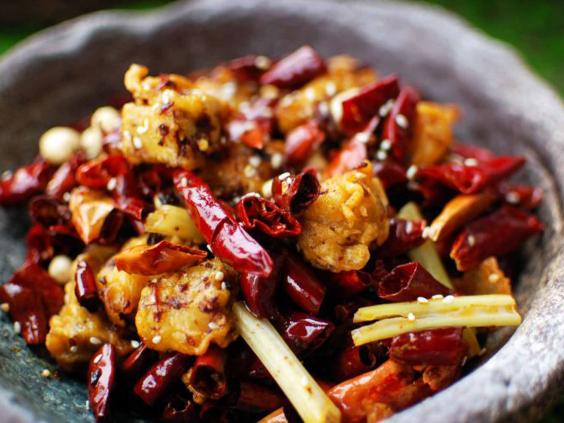
Despite the changes, on my most recent visit, a few weeks ago, Chengdu seemed to retain its easy balance between old and new. The spicy food – always regarded as some of the best in China – is central to the city's culture, its “private kitchens” (tiny restaurants set up in apartment blocks) offering a doorway not just to the local food, but also the lifestyle.
And while ever-mushrooming developments may contain wall-to-wall chains, people still flock to the traditional craft stalls of Jin Li and Kuanzhai Alley.
“As the city becomes more international, local people still follow tradition,” says Seven Zhu, who works at the city's newest hotel, The Temple House. “They drink tea and play mahjong, and I know more than 20 of my colleagues go for traditional tui na massage after work. We're moving towards the future but we're also holding on to our history.”
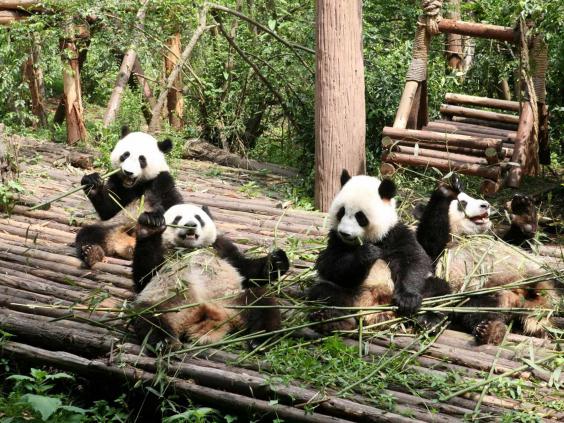 |
| Pandas (Alamy) |
It's that natural merger of east and west that makes Chengdu such a treat. It's manageable in size, with acres of green space (at weekends it seems half the city flocks to People's Park for dancing and qi gong), and has one-man craft stalls alongside behemoth developments, and a food scene that goes from strength to strength. A city that used to be best known for breeding pandas (a record 12 were born here this year) is now a fully fledged destination in itself.
Chengdu's luxury hotels tended to follow the Chinese model of bigger and blingier equals better. But that was until The Temple House (00 86 28 6636 9999; thetemplehouse.com) opened in July as part of the Taikoo Li complex. A sibling of Hong Kong's Upper House hotel, it's set around a century-old building, originally part of the Daci Temple complex, which houses the lobby, library and a gallery. Its vast, superbly equipped rooms and apartment-style “residences” sit in glass-fronted towerblocks on either side. But it's the service that stands out, with staff going the extra mile to plan your days – invaluable if Mandarin isn't your forte. Doubles from 1,699 Chinese yuan (£175).
THINK LOCAL
China's medical tradition, of course, dates back millennia, but accessing it as a tourist – even for something as simple as an acupuncture session – can be daunting. Not so at the recently opened Zan TCM (00 86 28 8628 5969; zanchina.taobao.com), which bears more resemblance to a spa than Chengdu's traditional communal clinics. Medical assessments are possible, though not encouraged, since the treatment plans are long-term; instead, get a taster with spa-style treatments such as tui na massage and moxibustion – a massage followed by heat application from smoking, herb-filled cones held over meridian points, which is as relaxing as a hot stone treatment.
 |

No comments:
Post a Comment